
Staff Training in Hospitality: The Complete Guide

Staff training in hospitality is everything that gets a new starter from “first shift” to “trusted with a section”, and keeps everyone else safe, legal and good at their job after that. It covers two very different things: the training the law asks for, and the skills that make guests come back. This guide covers both: what to train, the formats that actually work around shifts, how to build a plan, how to measure it and how to keep it the same at every site.
Want to start today? Our free training plan template gives you a training plan per new starter and a team training matrix in Excel, no email needed.
What staff training in hospitality covers
Most training in a restaurant, bar or hotel falls into five buckets. A good plan has something from each, in the right order.
- Mandatory training. Health and safety, fire, food hygiene, allergens, and licensing for anyone serving alcohol. Non-negotiable, and it has to happen before someone works alone.
- Role skills. Menu and drinks knowledge, steps of service, the pass, the till, cocktail specs, housekeeping standards. This is what guests notice.
- Brand and culture. How your business looks after guests and each other. The difference between a server and your server.
- Systems. The till, the booking system, the rota app, how to swap a shift and who to call when sick.
- People skills and leadership. Handling complaints, upselling without being pushy, running a shift, giving feedback. The bridge from team member to supervisor.
The order matters. Mandatory first, then the core of the role, then everything that makes someone great at it.
Mandatory vs role training
Mandatory training is what the law expects, role training is what your guests expect. Both need a plan, but they’re managed differently: mandatory training needs proof and refresh dates, role training needs practice and sign-off.
These are the main legal training duties for UK hospitality employers:
| Training | What the law asks | Source |
|---|---|---|
| Health and safety | Adequate training when people are recruited and when they face new or increased risks, repeated where appropriate, in working hours | Management of Health and Safety at Work Regulations 1999, reg. 13 |
| Fire safety | Safety training when people are first employed and when risks change, repeated periodically where appropriate | Regulatory Reform (Fire Safety) Order 2005, art. 21 |
| Food hygiene | Food handlers supervised and instructed or trained in food hygiene to match their work | Regulation (EC) 852/2004, Annex II, Chapter XII |
| Allergens | “Food businesses must make sure that staff receive training on allergens” | FSA allergen guidance for food businesses |
| Age verification | Staff who serve alcohol must know your age verification policy (most venues run Challenge 25) | Section 182 guidance, Licensing Act 2003 |
The law rarely sets a fixed renewal date for these. “Repeated where appropriate” means you decide, write it down and stick to it: for example yearly for allergens and fire safety, and every three years for food hygiene. For the detail on each, see our guide to compliance training in hospitality.
Role training has no legal floor, which is exactly why it drifts. If the standard for “knows the menu” isn’t written down, every manager invents their own.
Training formats that fit a shift pattern
Hospitality teams don’t sit at desks. People work different days, split shifts and late closes, and plenty of them are part-time. The formats that work are the ones that fit around that.
On-shift training
Shadowing a strong team member, then doing it with backup, then doing it alone. It’s how most hospitality skills are really learned, and it’s free. The catch: it’s only as good as the person being shadowed. Give every new starter a named buddy, rota them on the same shifts and tell the buddy exactly what to cover.
Microlearning
Lessons of two to five minutes on the phone: one dish, one allergen rule, one cocktail spec, with a quick quiz at the end. Short enough to do on the bus or before a shift, focused enough to remember. We’ve collected 11 ways microlearning changes restaurant training.
Blended learning
Knowledge on the phone, skills on the floor. The digital part makes sure everyone hears the same thing; the hands-on part turns it into habit. It works best when the practice follows within a few days. More in what blended learning is and how to run blended learning across sites.
Workshops, tastings and masterclasses
Wine tastings, a chef walking the team through a new menu, a service masterclass before a launch. Expensive in time, so keep them for what can’t be learned any other way, and put the prep reading and the follow-up quiz on the phone.
What to stop doing
The 50-page PDF handbook that nobody reads past page three. The one-off induction day that dumps everything at once. Training “when it’s quiet”, which never comes.
How to build a staff training plan
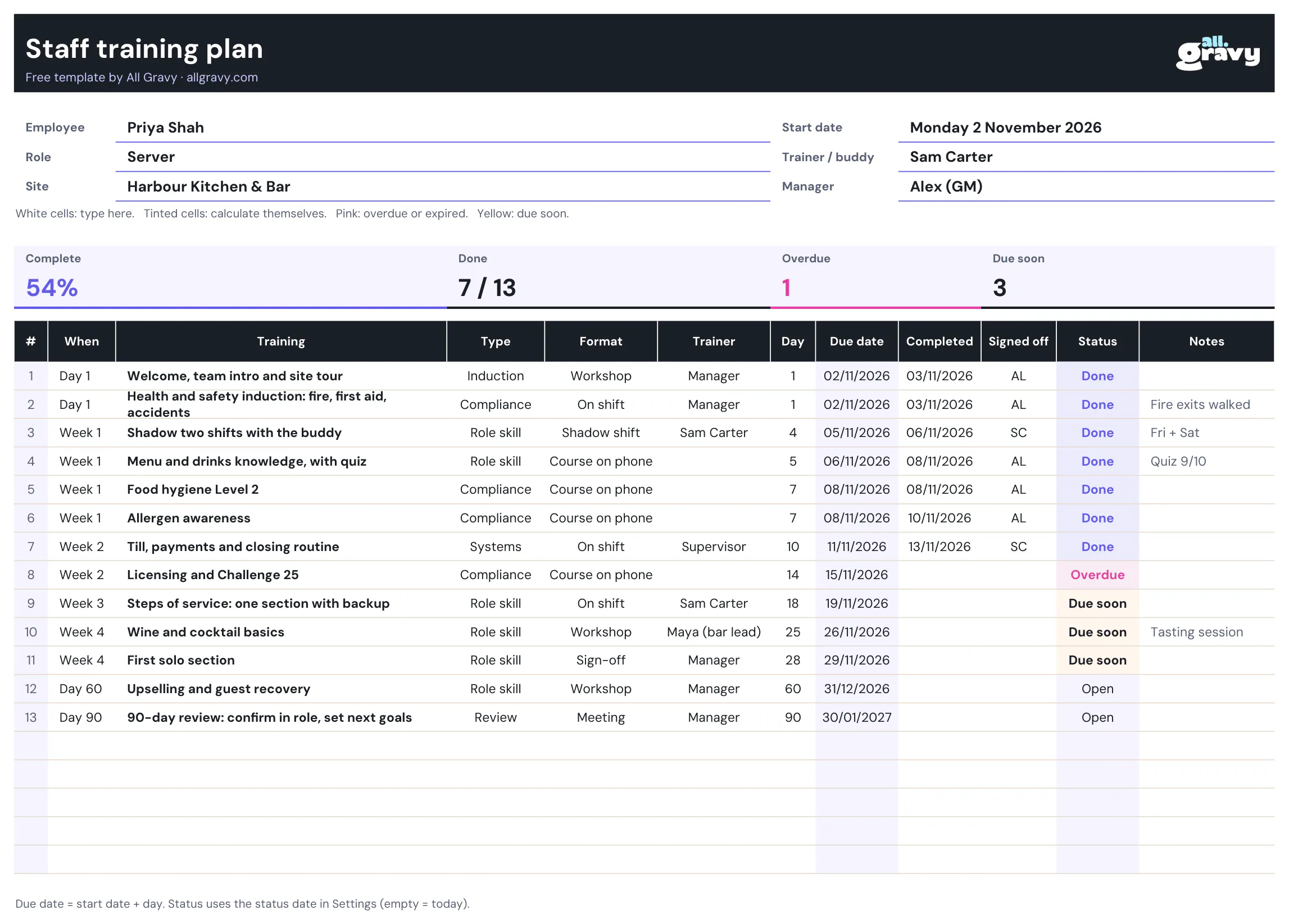
A training plan turns all of the above into who learns what, by when, and who signs it off. Build one per role, then copy it per new starter.
- List what the role needs. Mandatory training first, then the role skills, then the systems. Ask your best person in that role what they wish they’d been taught.
- Put it in order. What must happen before a first shift, in week one, by week four and by day 90.
- Pick the format per item. Course on the phone, on shift with a buddy, workshop or sign-off.
- Name a trainer for everything on shift. Without a name, it doesn’t happen.
- Set due dates from the start date. Day 1, day 7, day 28. Then you can see what’s overdue.
- Agree what “done” means. A quiz pass mark, a manager watching one full service, a checklist signed off.
- Set refresh dates. For mandatory training, decide how often it’s repeated and track who is about to expire.
Our free training plan template does this in Excel: a plan per new starter with due dates and status, and a training matrix for the whole team that turns yellow before training expires.
Staff training ideas that work in hospitality
Ten ideas that work on a real shift pattern, not just in a training room:
- Five-minute pre-shift huddles. One dish, one allergen, one upsell. Every shift, same format.
- Taste the menu. Staff can’t sell a dish they’ve never eaten. A tasting before every menu change pays for itself.
- Menu quizzes on the phone. Ten questions, a pass mark, a badge. Repeat after every menu change.
- Buddy shifts with a checklist. The buddy knows exactly what to cover, the new starter knows what’s coming.
- Role-play the hard moments. The allergy question, the complaint, the guest who has had enough to drink.
- Cross-training. Servers spend an hour on the pass, chefs an hour on the floor. Fewer “that’s not my job” moments.
- Let your best people teach. Film your top bartender making the signature serve and turn it into a lesson.
- Mystery guest, then debrief. Score the visit and use it to coach the team, not to punish it.
- Celebrate finished training. A shout-out in the team feed when someone completes a course or earns a badge.
- A path to supervisor. Show people what they need to learn for the next role. It’s training and retention in one.
How to keep training consistent across sites
At one site, training lives in the GM’s head and works. At five sites it lives in five heads and looks different everywhere. At twenty, head office has no idea who has done what until something goes wrong or an inspector asks.
Consistency comes from three things:
- One standard, written once. The menu course, the steps of service, the allergen process: built centrally, the same for every site, updated in one place.
- The same delivery everywhere. If one site uses a binder, another a WhatsApp video and a third the GM’s memory, you get three standards. Deliver the knowledge the same way, then let each site run the hands-on part.
- Visibility per site. Completion, overdue training and expiring certificates per site, so area managers can act before the audit, not after.
This is usually the point where a spreadsheet stops working and a learning platform pays off. Our 12-point checklist for a hospitality LMS covers what to look for.
How to measure staff training
Most groups measure training by whether it was finished. That’s the easiest number to get and the least useful one on its own. Work up the steps:
- Finished. Completion and overdue training per course, site and person. The minimum you need for compliance.
- Learned. Quiz scores and pass rates. Which questions everyone gets wrong tells you what to teach better.
- Applied. Does it happen on shift? Manager sign-off, checklists, audits, mystery guest scores.
- Results. Time to first solo shift, guest feedback, allergen incidents, and how many new starters are still there after 90 days.
That last one matters more than it looks. New starters who feel prepared stay; new starters who are thrown in on a Friday night leave. Our Hospitality Retention Benchmark 2026 looks at what keeps hospitality teams together.
Onboarding and training are one journey
Onboarding is where training starts. The first week sets the tone: a new starter who gets a buddy, a clear plan and a few short lessons before their first busy shift learns faster than one who gets a handbook and a “shout if you need anything”.
Start before day one with preboarding, plan the first 90 days with our guide to onboarding and use the free onboarding checklist template to make sure nothing gets missed.
Where a training app fits
Spreadsheets, binders and WhatsApp videos work at one or two sites. Past that, the admin takes over: chasing who has done what, re-sending the same PDF, building the audit file the night before the inspection.
With the All Gravy LMS, training lives in the app your team already opens for chat, the feed and handbooks:
- Short courses on the phone, with a quiz at the end, sent to the right roles and sites. New starters in that role get them automatically.
- Ready-made compliance courses for hospitality, such as Food Safety Level 2 and Allergen Awareness, so you don’t write your own.
- Deadlines, reminders and refreshers, so nobody has to chase and expired training comes back on its own.
- Workshops and tastings inside the course, with sign-up and attendance, so the hands-on part counts too.
- Completion per course, site and person, and an export for when the inspector or head office asks.
- Courses built from your own material by the AI Assistant. Nothing goes live until you approve it.
Teams like The DRG use one app for training and comms across their brands. To see it with your own courses, book a demo.
Frequently asked questions
What training do hospitality staff need?
Two kinds. Mandatory training the law asks for, such as health and safety on joining, fire safety, food hygiene for food handlers, allergens and, at the bar, your age verification policy. And role training: menu and drinks knowledge, steps of service, the till, kitchen standards and the way your brand looks after guests.
Is staff training a legal requirement in the UK?
Parts of it are. Employers must give adequate health and safety training when people start and when risks change, fire safety training when they are first employed, and food handlers must be supervised and instructed or trained in food hygiene to match their work. Food businesses must also train staff on allergens. Sources are in the table above.
How long should hospitality staff training take?
The mandatory part should be done before someone works a shift alone, usually within the first week. Role skills take longer: most front of house roles need two to four weeks of on-shift practice before a first solo section, and the learning carries on after that.
What is the best way to train restaurant staff?
Short lessons on the phone for the knowledge (menus, allergens, safety), practised on shift within a few days with a named buddy, then signed off by a manager. That blend fits shift work far better than a long classroom session or a 50-page PDF.
How do you measure staff training?
Start with completion and overdue training per site, then quiz results, then whether people do it on shift (manager sign-off, audits), then business results such as time to first solo shift, guest feedback and how many new starters are still there after 90 days.
How do you keep training consistent across sites?
Write the standard once, deliver it the same way everywhere and see completion per site in one place. Leave site managers to run the hands-on part and sign it off. Training that lives in each manager’s head changes at every site.