
Free Restaurant Checklist Templates: Opening, Closing, Cleaning and Handover

These free restaurant checklist templates cover the four lists every site runs on: an opening checklist, a closing checklist, a weekly kitchen cleaning schedule and a shift handover template. They come in one Excel file that does the counting for you, with a printable PDF of each list for the clipboard by the pass. Download them, change the tasks to match your site and you have tomorrow’s checks ready tonight.
What’s in the free restaurant checklist templates
Each tab prints on one A4 page and works on a tablet too.
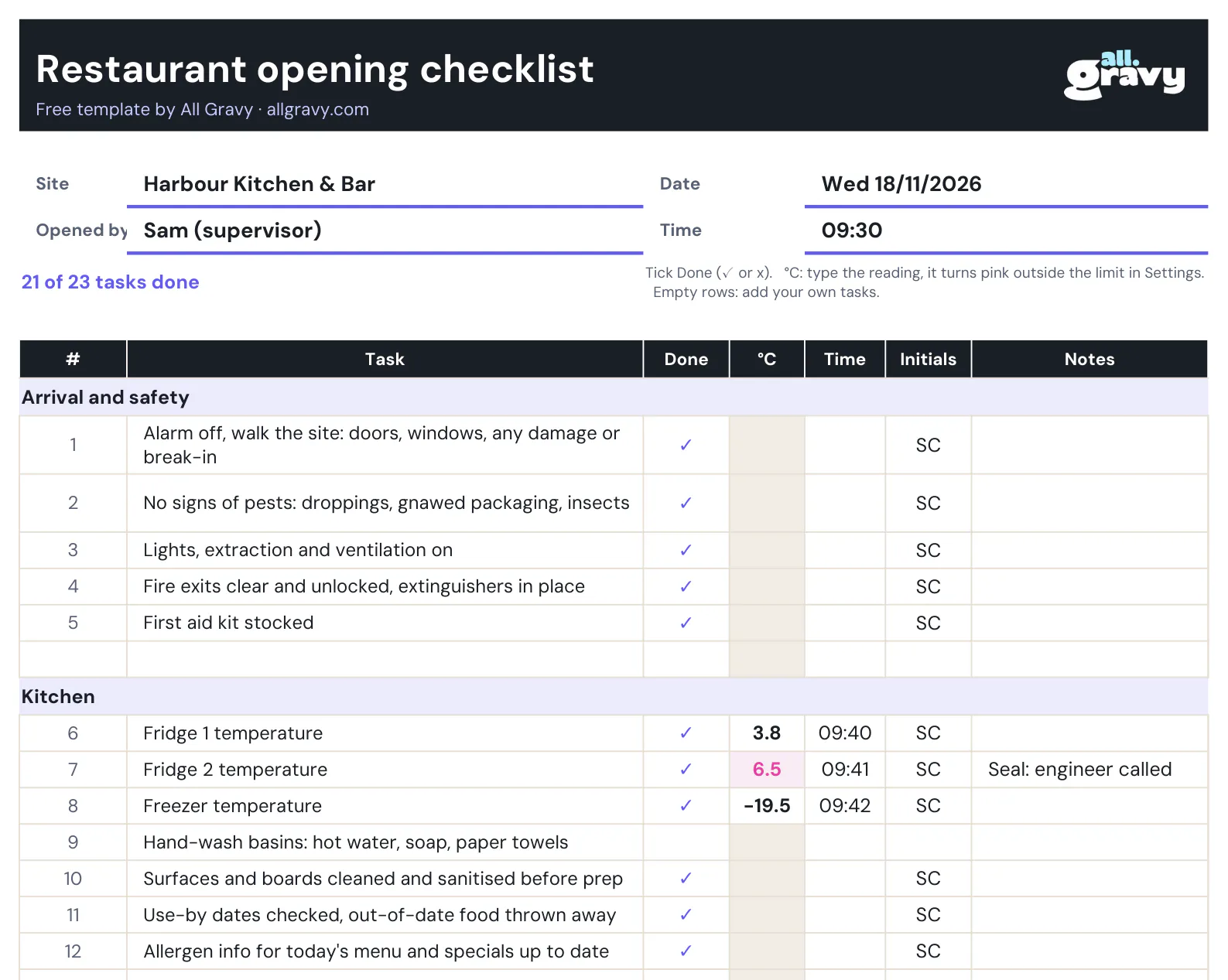
- Opening checklist. 23 tasks across arrival and safety, kitchen, front of house and bar, and the team. A counter at the top shows how many are done.
- Closing checklist. 23 tasks across kitchen, bar, front of house and lock-up, ending with handover notes and the alarm.
- Kitchen cleaning schedule. A weekly cleaning rota with what to clean, how and how often. Initial the day you did it and the sheet shows what is still to do this week.
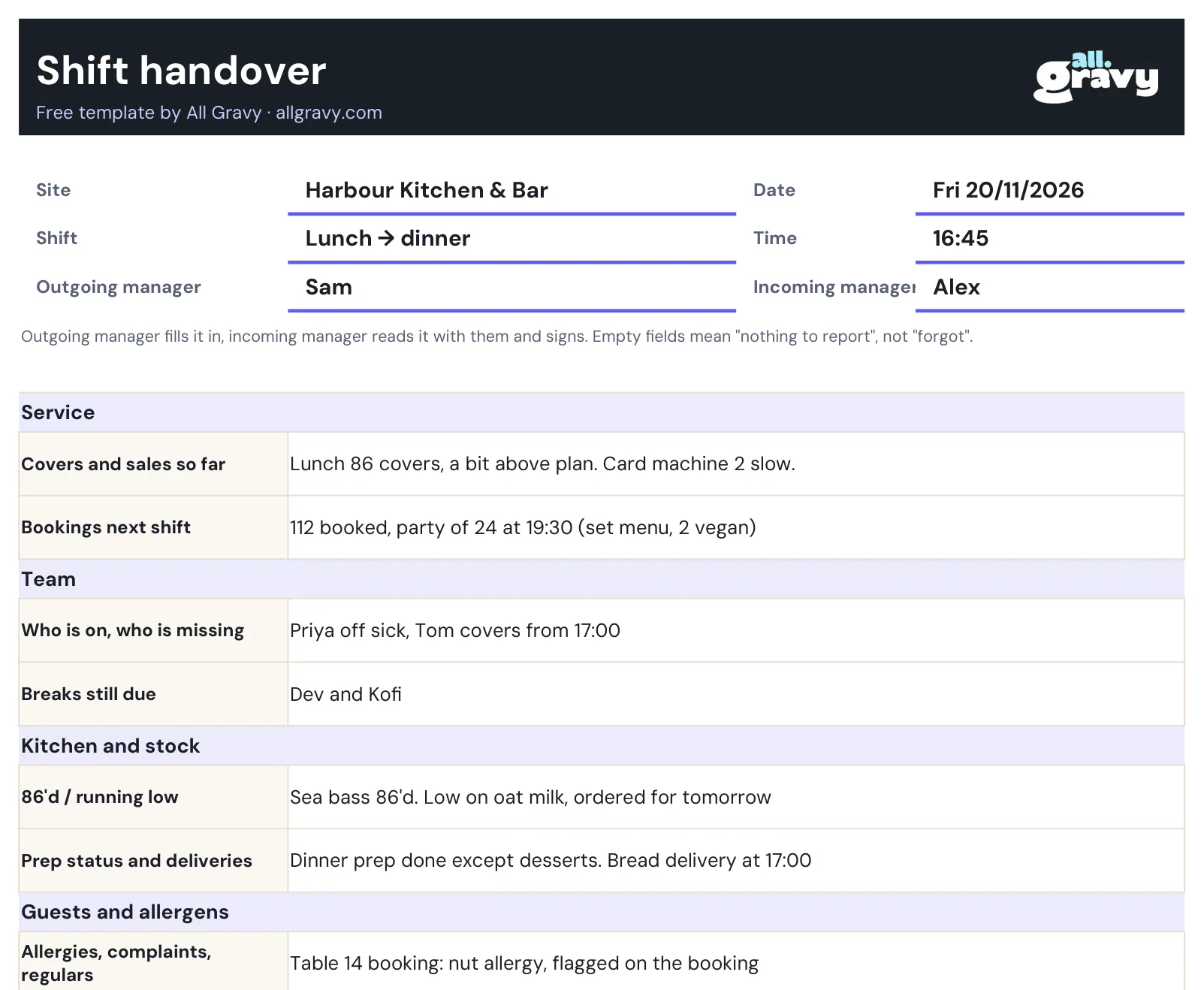
- Shift handover template. One page for the outgoing manager to hand over service, team, stock, guests, equipment, cash and open tasks, signed by both.
The temperature rows on the opening and closing checklists turn pink when a reading is outside the limit you set on the Settings tab. The limits are example values: use the ones in your own food safety plan. Every list has empty rows for your own tasks, a notes box and a sign-off line for the manager.
Restaurant opening checklist
The opening checklist gets the site safe, the kitchen ready and the team briefed before the first guest walks in. It runs in the order people actually move through a building: alarm and walk-round first, then the kitchen, then front of house and bar, then the team.
- Arrival and safety: alarm off, a walk-round for damage, signs of pests, fire exits clear, first aid kit stocked.
- Kitchen: fridge and freezer temperatures, hand-wash basins stocked, surfaces sanitised before prep, use-by dates checked, allergen info current, hot holding up to temperature.
- Front of house and bar: tables, toilets, card machines and float, ice machine, glass washer, garnishes.
- Team: everyone in or cover arranged, nobody handling food while unwell, a short pre-shift briefing on bookings, specials, 86’d items and allergens.
Restaurant closing checklist
The closing checklist protects tomorrow. Food goes away covered and dated, equipment goes off, the site gets cleaned and locked, and the next shift gets a note about anything that went wrong.
- Kitchen: food covered, labelled and stored, leftovers cooled or thrown away, fridge and freezer temperatures, fryers, grills and gas off, surfaces, floors and drains clean, bins out, dishwasher drained.
- Bar: fridges restocked, nozzles and drip trays cleaned, glass washer drained.
- Front of house: tables cleared, toilets cleaned, till cashed up, card machine totals run.
- Lock-up: the day’s cleaning schedule signed off, taps and lights off, nobody left on site, handover notes written, alarm set.
How to make an opening and closing checklist stick
A checklist only works if people use it on the busy days too. Five things make the difference:
- One owner per shift. A list everyone can tick is a list nobody owns. Put a name at the top.
- Checkable tasks. “Fridge 1 at or below the limit” can be checked. “Check fridges” can’t.
- The order of the building. Follow the route people walk, so nobody doubles back.
- A reading, not just a tick, where it matters. A temperature written down is worth more than a tick next to “fridges OK”.
- A manager who looks. Read yesterday’s sheets at the start of the shift and ask about the gaps. Lists that nobody reads stop getting filled in.
Kitchen cleaning schedule and cleaning rota template
A kitchen cleaning schedule says what gets cleaned, how, how often and who signed it off. This one runs as a weekly cleaning rota: daily, twice-weekly and weekly tasks for the kitchen, bar, front of house and toilets, with a column per day for initials.
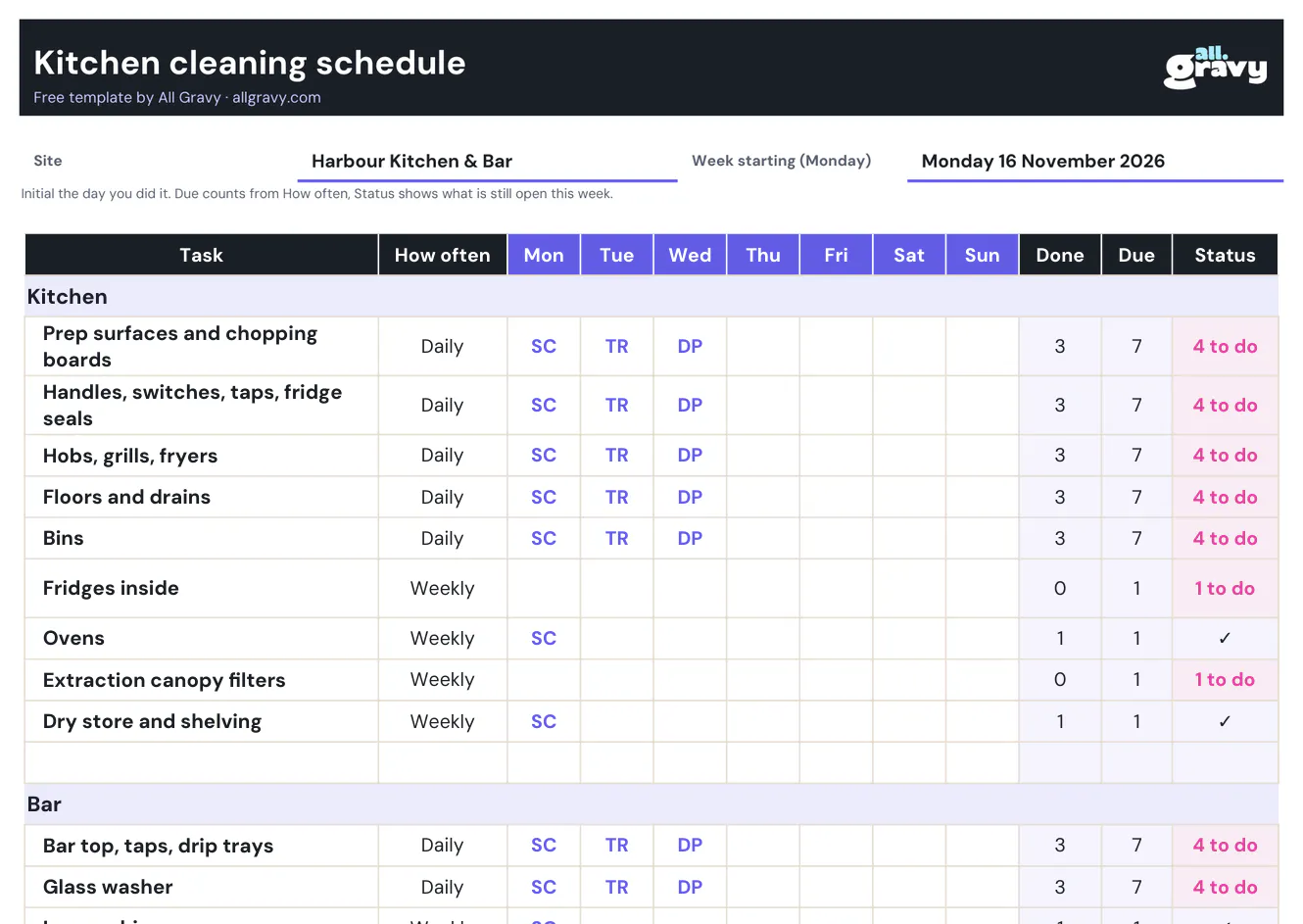
- Daily: prep surfaces and boards, hand-contact points like handles and switches, hobs, grills and fryers, floors and drains, bins, the bar top and glass washer, tables and toilets.
- Weekly: fridges inside, ovens, extraction canopy filters, the dry store, the ice machine, beer lines (or as your supplier says).
- Monthly and deep cleans: behind and under equipment, walls and ceilings, freezer defrost, the bin store and extraction ductwork, logged with a date and when it’s next due.
Write the method next to each task, including the contact time for your sanitiser, so a new starter cleans it the same way as the person who has done it for three years. For tasks that need more than a line, write a short SOP: our guide to standard operating procedures shows how.
Shift handover template
A shift handover passes on everything the next manager needs to know and can’t see: the party of 24 at 19:30, the dish that has run out, the fridge with a faulty seal, the server who went home sick. Without it, that information walks out of the door with the outgoing manager.
What to include in a shift handover
- Service: covers and sales so far, bookings and large parties for the next shift.
- Team: who is on, who is missing, breaks still due.
- Kitchen and stock: what is 86’d or running low, prep status, deliveries due.
- Guests and allergens: allergy notes on bookings, complaints to follow up, regulars.
- Equipment and safety: anything broken and who was called, accidents and near misses.
- Cash: float and safe checked, any differences.
- Open tasks: what still needs doing, by whom and by when.
How to run a good shift handover
Do it face to face, at the same time every shift, and keep it to five minutes. The outgoing manager fills in the sheet before the overlap, they walk through it together, and the incoming manager signs it to say they have read it and taken it over. An empty field should mean “nothing to report”, not “forgot”. Keep the signed sheets: next week they tell you why the fridge engineer was called and who knew about it.
Checklists and food safety records
Food businesses need food safety procedures based on HACCP principles, with records that fit the size of the business (Regulation (EC) No 852/2004, Article 5). In England and Wales, the Food Standards Agency’s Safer Food Better Business pack is the common way small caterers do this: it builds daily opening and closing checks into the routine and asks for daily records in a diary.
These templates help you run and record those daily checks. They don’t replace your food safety plan, and the temperature limits in Settings are examples: set the ones your plan uses. Teach the standard behind each check too, for example with compliance training for food safety and allergens.
Make the templates your own
- Cut before you add. A 60-line list gets skimmed. Keep what matters at your site and delete the rest.
- Split by role if you need to. Kitchen and front of house can have their own opening lists. Copy the tab and trim it.
- Review when something changes. New menu, new equipment, a new allergen on a dish: update the list that week.
- Keep one version. One master file at head office, printed fresh at each site, beats ten edited copies that drift apart.
When paper checklists stop working at 5+ sites
A paper checklist tells you what happened at one site, a day later, if someone finds the clipboard. At five sites you have five versions of the opening list, and the only way to know whether the fridges were checked in Brighton is to call Brighton.
All Gravy to-do lists put the same checklists on the phone in the app your team already uses:
- A list for every site and role, so the kitchen sees kitchen tasks and the bar sees bar tasks.
- Lists that repeat themselves, daily or on set days, and are there when the shift starts.
- Every site at a glance. See from the web app how far each location is, and look back at any day.
- One standard, copied in seconds to the next site you open.
Problems that don’t fit on a list, like a broken coffee machine, go in a report with a photo to the people who fix them. For the people side of keeping every site on the same page, our guide to task management for restaurants goes further. Or book a demo and bring one of your paper checklists.
Frequently asked questions
Are the restaurant checklist templates free?
Yes. Download the Excel file with all four checklists, or a printable PDF of each one, straight from the page. No email, no sign-up.
What should be on a restaurant opening checklist?
Safety first (alarm, walk-round, fire exits, pests), then the kitchen (fridge and freezer temperatures, hand-wash basins, clean surfaces, use-by dates, allergen info), front of house and bar (tables, toilets, till float, ice machine) and the team (everyone in, nobody unwell, pre-shift briefing).
What should be on a restaurant closing checklist?
Food covered, labelled and stored, fridge and freezer temperatures, equipment and gas off, surfaces and floors cleaned, bins out, bar and front of house reset, the till cashed up, the day’s cleaning signed off, handover notes written, doors locked and the alarm set.
What is a shift handover template?
A one-page sheet the outgoing manager fills in for the incoming one: how service went, who is on and who is missing, what is 86’d or running low, allergy notes and guest issues, broken equipment, accidents, cash, and the open tasks with a name and a time. Both sign it.
How often should a restaurant kitchen be cleaned?
Prep surfaces, boards and hand-contact points during and after every service, floors and bins daily, fridges, ovens and extraction filters weekly, and deep cleans like behind equipment and extraction ductwork monthly or as your contractor advises. Write the frequency next to each task in a cleaning schedule.
Do the templates work in Google Sheets?
Yes. In Google Sheets go to File, Import and upload the .xlsx. The progress counter, the temperature flags and the cleaning schedule status come with it. It also opens in Excel and LibreOffice.
Do I have to keep opening and closing checks?
Food businesses need food safety procedures based on HACCP principles and records that fit the size of the business. In England and Wales, the Food Standards Agency’s Safer Food Better Business pack builds daily opening and closing checks and a diary into this. The templates help you keep those records; they don’t replace your food safety plan.